
Pink is not that Shrimple
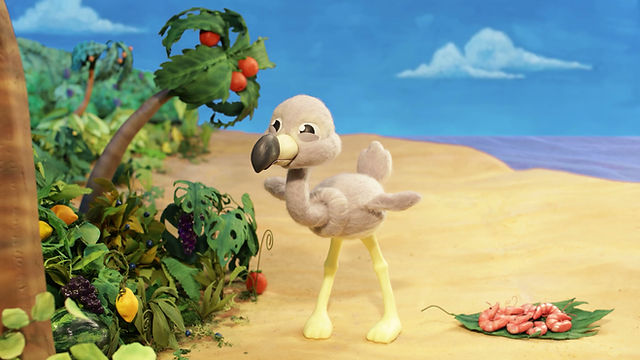
I worked as a lead fabricator on Pink is not that Shrimple, a collaborative stop motion short created in ten weeks. The film follows Mingo, a gray flamingo who is allergic to shrimp, attempting to turn pink by eating colorful fruits. I am responsible for pre-production, fabrication, and cinematography.

I primarily worked in the puppet department, where we built six twelve-inch flamingos. We started by sculpting detachable body parts (head, beak, neck, wings, torso, tail, legs) out of Chavant Medium NSP. We cast silicone molds for all body parts, except the legs, which required a two-part urethane mold. We then constructed the interior polycarbonate armatures, which we rigged from the back and side. After we placed the head, neck, torso, and tail armatures into their molds, we cast each part in foam. We used Smooth Cast 300 plastic to make the beak, and GI 1000 silicone for the legs. We needle-felted the foam, painted the beak, and dremeled the leg seams to achieve uniformity across all six puppets.

I assisted with the macaw construction. First, the production design department sculpted the body out of Chavant Medium NSP, while I tested ways to rig the felt wings and tail. I used 24 ga. black annealed steel wire for flexibility in the feathers. We then made a two-part plaster mold to hold the polycarbonate armature, which we rigged from the top. We cast the body in foam, and all parts were needle-felted. We made a separate silicone mold for the face, which we cast in plastic and hand-painted.

As one of the storyboard artists, I developed Mingo's poses, mannerisms, and expressions. After illustrating mechanical facial blueprints, I Vaquformed the eyes, lids, and pupils. I attached the replaceable pupils and highlights with Museum Wax. I also cast, sanded, and rigged the beaks, which we designed to plug into the face for easy swap-outs.
I adjusted lighting setups, oversaw equipment, and troubleshot lighting issues that arose during production. I referenced my storyboards to implement creative and technical decisions regarding camera positions, angles, and lenses. I helped plan, cut, and animate the downshoot transitions as needed.

I collaborated with the production design department to cut, rig, and airbrush the crepe paper foliage. We also hot-wire sculpted pink foam to create the beach assets. We installed the sand base, foliage, and blue screen background with the animator's position in mind.

After the production design department sculpted the fruit, I created the GI 1000 silicone molds. We cast the fruit in transparent plastic, and the production design department painted them with nail polish. When I was installing this set, I attached color gels to the lights to achieve the glossy look outlined in the style guide.


I fabricated two sets for Moticos, the 2026 SCAD stop motion capstone. The film follows a heartbroken woman who finds release through violence. I am responsible for mockups, modeling assets in Rhino, and fabricating landscapes.

I sculpted the road out of paper clay on a 3/4" MDF base. I made the grass out of rope, towel, and burlap.

I fabricated the landscape with painted linen, corduroy, and towel scraps. Everything is painted with an acrylic wash.